The Roman Theater in Ankara — an ancient stage at the foot of the citadel
On the western slope of the Ankara Citadel, near the Bentderesi River, lies a monument that is nearly two thousand years old. The Roman Theater in Ankara (Ankara Roma Tiyatrosu) was built in the 2nd century CE and could seat 3,000–5,000 spectators. For a long time, it was literally buried beneath the city: it wasn’t until 1982, during excavation work for a construction project, that the first archaeological traces were discovered. From 1982 to 1986, the theater was excavated by the Museum of Anatolian Civilizations, and excavations resumed in 2009–2010. Today, the Roman Theater in Ankara is a protected cultural heritage site, one of the few large ancient theaters found right in the heart of a modern metropolis, and a place where the history of Ancyra unfolds before the visitor’s eyes not in display cases, but right beneath their feet.
History and Origins of the Roman Theater in Ankara
Ancyra—as modern-day Ankara was known in ancient times—was the capital of the Roman province of Galatia. The city occupied a strategic position at the crossroads between the West and the East, and its importance during the Roman Empire was considerable. The theater was built in the 2nd century CE—during the heyday of provincial construction under the emperors Hadrian and the Antonines. The exact date of its foundation is unknown, but the typology of architectural elements and building materials point specifically to this era.
The building was erected on the western slope of the hill of the Ankara Fortress, above the Bentderesi River. This is a technique typical of theaters in Asia Minor: the use of natural terrain instead of earthworks. It was precisely this principle that the Roman architect Vitruvius wrote about in his treatise *De Architectura*—and the Ankara theater vividly confirms his words: the sloping hillside of the fortress allowed for the avoidance of massive earthworks during the construction of the cavea.
After the theater gradually fell out of active use in the 3rd–4th centuries, it was adapted for new purposes during the Seljuk and Ottoman periods: excavations in 2009–2010 revealed traces of ceramic and glass production within the theater building. Defective ceramics, tubes, and coins discovered in situ indicate the operation of workshops during the late medieval period—the former theater had been transformed into a neighborhood industrial zone. In 1992, the site was placed under state protection as a Category I and II monument. Following the 2009–2010 excavations, the theater was transferred to the Greater Municipality of Ankara for restoration.
The restoration sparked heated debate among experts. It was decided to completely renovate the cavea; in the process, the original Ankara stone—andesite—was replaced with white marble. Many experts viewed this as “building a new theater from scratch” rather than preserving a historic site.
Architecture and What to See
The Ankara Roman Theatre is located between Hisar Caddesi and Pınar Sokak in the Ulus district (Altındağ). Architecturally, it is a typical Roman theater of the Asia Minor type with a number of distinctive features.
Cavea: 3,000–5,000 seats
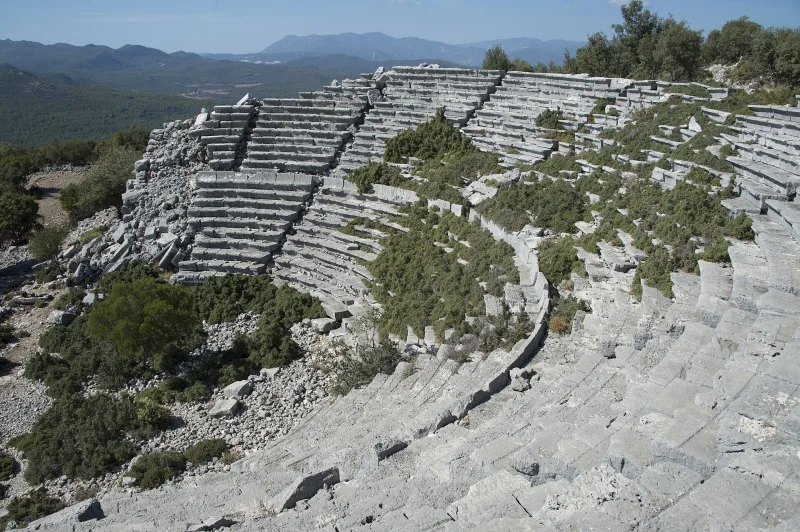
The cavea (auditorium) is oriented approximately 23° northwest, which allows for the circulation of cool air from the Bentderesi Valley—a sound acoustic and climatic solution. Horizontally, it was divided into four sections with seating and radial staircases. According to researchers’ calculations, the theater could seat between 3,000 and 5,000 spectators—a relatively small size by the standards of Anatolian theaters, reflecting Ancyra’s provincial rather than imperial scale. Originally, the cavea was built of andesite—a local volcanic rock; during restoration, concrete and white marble replaced a significant portion of the original structures. Two original rows of andesite seats, approximately 40 centimeters high, were discovered in their original location.
Vomitoria and Parodes
Vomitoria—vaulted passageways—were used to access the auditorium and the orchestra. Both tunnels leading to the orchestra have survived to this day. Of the two parodos (entrance corridors for the choir and actors), the eastern one has survived completely, while the western one has survived only partially.
Orchestra and Pulpitum
The orchestra (the choir platform) is semicircular, with a diameter of about 13 meters, and is surrounded by a thick wall. The pulpitum (stage) has survived, though it was modified during the Byzantine era: new structures were added between the stage and the orchestra, lowering the height of the doorways. This indicates that the theater was adapted for other purposes in later periods.
Scene and Sculptures
Only the northern part of the skene (stage) has survived. It was built of andesite blocks, is about 31 meters long and 8 meters wide, and features five doorways—a non-standard design characteristic of the Asia Minor theatrical tradition. Architectural details and fragments of sculptures found during excavations point to a rich decorative program. Most of the finds are housed in the lower halls of the Museum of Anatolian Civilizations.
Interesting Facts and Legends
- The theater was discovered by chance in 1982 while digging a construction pit. Prior to that, it had lain buried under a layer of urban debris for about 1,500 years.
- During the Seljuk and Ottoman eras, the theater building was used as workshops for the production of ceramics and glass—as evidenced by the defective artifacts and glassblowing pipes found there.
- The restoration of the cavea in 2020 sparked controversy: the use of white marble instead of the original andesite drew criticism from experts, who described the result as “building a new theater on the site of the ancient one.”
- The theater’s cavea is oriented to take advantage of natural ventilation from the Bentderesi River valley—a design choice in line with Vitruvius’s recommendations for selecting a theater site.
- The type of stage with five doorways is a characteristic feature of the Anatolian theatrical tradition, distinguishing local theaters from standard Roman structures with three doors.
How to get there
The theater is located in the Ulus (Altındağ) district of Ankara, between Hisar Caddesi and Pınar Sokak, at the western foot of the Ankara Citadel. It is about a 10–12-minute walk from the Ulus metro station (Line M1). The metro ride from the central Kızılay district to Ulus takes 5 minutes.
From Ankara Esenboğa Airport (ESB), the most convenient way is to take the Havaş bus to one of the central stops, then the metro to Ulus. Near the theater are the Temple of Augustus and Hacı Bayram Camii—all three sites can be conveniently visited on a single tour through historic Ulus. It is about a 600-meter walk from the Ankara Roman Baths (Roma Hamamı) to the theater.
Tips for travelers
The site is fenced off; to visit, check the opening hours and ticket availability—access may vary depending on the season and ongoing construction. We recommend checking the latest information on the Ankara Municipality website or at the tourist office.
The theater is particularly striking when viewed from the upper levels of the Ankara Citadel—from there, you can clearly see the overall layout and the site’s location within the urban landscape. Visit the theater in the morning: there are no crowds of tourists, and the soft light beautifully highlights the texture of the stonework. Wear shoes with non-slip soles: the stone can be slippery after rain.
Combine your visit with a trip to the Museum of Anatolian Civilizations (Anadolu Medeniyetleri Müzesi)—it’s a 5-minute walk away and houses most of the artifacts found during the theater’s excavations. The Roman Theater in Ankara is a rare example of an ancient site existing right in the heart of a living urban environment: here, the history of Ancyra can be felt literally under your feet, rather than behind the glass of a museum display case.